An “Ichigo Ichie” of Light
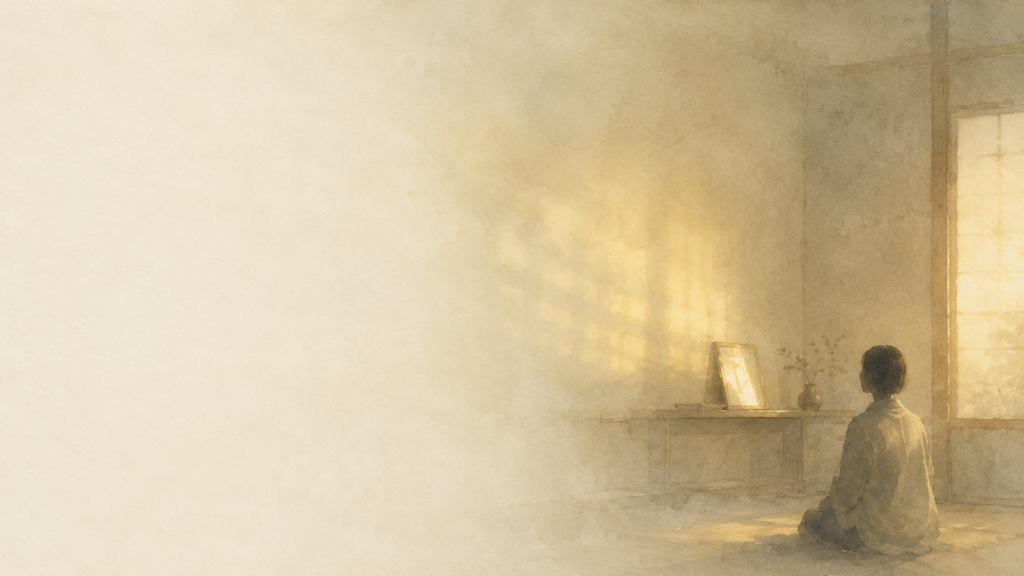
Just before evening, there are moments when a room turns pale gold.
The light of the day has already lost the strength of noon, yet it has not fully sunk into night. Outside the window, the air grows quiet. The color of the sky, the color of the walls, even the edges of familiar things seem to soften a little.
At such an hour, sunlight may enter through the window and touch the glass of a photo frame placed on a shelf.
Only a small angle is needed.
The glass, usually too ordinary to notice, receives the evening light and returns it toward the far wall of the room. It does not create a sharp, clear patch of brightness. Instead, the light spreads softly across a wide part of the wall, vague and gentle, as though it has lost its outline on the way.
It is not the whiteness of wallpaper.
It is not the brightness of an electric lamp.
It is a soft brightness, carrying a faint shade of gold.
The room is one that has been lived in for a long time.
There is no need to check where anything is. The height of the shelf, the position of the desk, the marks on the wall, the way the window opens ― the body remembers these things before the eyes do. Over time, a room becomes less something to be looked at than something that simply exists around daily life.
Yet when that light appears, the familiar room becomes, for a short while, a place slightly unknown.
The light that has spread across the wall does not seem to stop there. The wall itself appears to receive it, soften it, and quietly return it once more into the room. The shelf, the desk, the floor, and the air between them remain exactly as they were. Nothing has been moved. Nothing has changed.
And yet the whole room is held in a pale golden hush.
For a moment, it seems to have stepped a little away from ordinary reality.
There is a Japanese phrase, ichigo ichie.
It is often associated with the spirit of the tea ceremony. A meeting with another person, even if that person is seen many times, can never be repeated in exactly the same form. This one gathering, this one hour, this one presence before another ― each is singular. Because of that, attention is given to the moment as something that will not return.
But perhaps ichigo ichie does not belong only to encounters between people.
There may also be an ichigo ichie of light.
The height of the sun on that particular day. The thinness of the clouds. The direction of the window. The angle of the photo frame. The way the light spreads over the wall. The quiet gold that fills the room. The state of mind of the person who happens to be there.
All of these meet only for a short time.
Together, they create a pale golden hour inside an ordinary room.
The next day, even at the same time, the same light may not come. If the photo frame has been moved a little, the reflection will change. If the sky is cloudy, nothing may happen at all. If no one notices it, the light may appear and disappear without ever becoming a memory.
There is something slightly sad about that.
Yet perhaps its beauty is close to that sadness.
Many small moments in Japanese life seem to have been shaped by this kind of attention. Watching cherry blossoms, listening to rain, noticing the faint light through a paper screen ― none of these is an act of possession. They are not things to be held, fixed, or kept.
One simply stays with what has appeared.
Beauty is not taken into the hand.
One merely happens to be present where it passes.
There is a quiet pleasure in that.
A room touched by light before evening may be much the same. Nothing special has happened. No visitor has arrived. No great meaning has been announced.
Only the usual room has shown another face.
And that is enough to make the heart pause.
Daily life sometimes opens a small stage within itself. The person living there may have stopped seeing it, but the room, the light, the objects, and the hour are not always the same. They only seem to be.
When they are noticed, they become an encounter.
When they are not, they simply pass.
The pale gold gradually fades.
The brightness on the wall grows weaker. The glass of the photo frame becomes only glass again. The golden air that had filled the room quietly loosens, until nothing remains but the familiar silence of the shelf, the desk, the wall, and the evening.
Yet a little while before, another kind of time had certainly been there.
Inside a room where nothing had changed, something had happened only once.
To know that is enough to make ordinary life feel a little deeper.
Perhaps ichigo ichie does not happen only in special places.
It may also be found in the far corner of a room before evening.
Light enters through a window, touches glass, spreads across a wall, fills the room with a faint gold, and disappears.
That alone, for some reason, becomes difficult to forget.
More in
Memories
Or wander further through
Archive