“Inu mo arukeba bou ni ataru”
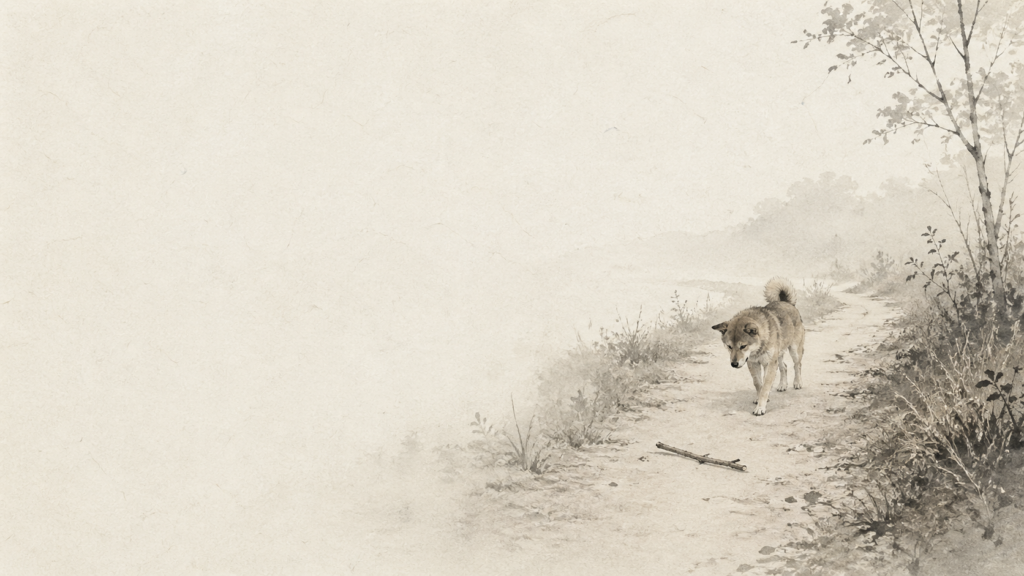
There is something, perhaps, a little human in the sight of a dog walking along the roadside.
It does not seem to be pursuing any grand purpose. It simply does not stay still. Nose lowered, it moves this way and that. Watching such a creature, it becomes a little easier to understand why people long ago placed a dog inside a proverb.
Inu mo arukeba bou ni ataru.
This first card of the Iroha Karuta was once a warning.
If even a dog wanders about carelessly, it may be struck by a stick. Better not to move unnecessarily. Better not to invite trouble. That was, once, the meaning.
A similar feeling may be found in other old sayings as well.
“The pheasant would not be shot if it did not sing.”
“The stake that sticks out gets hammered down.”
In each of them, there is a quiet wish for an undisturbed life. Not to stand out. Not to stir trouble. Not to draw needless harm upon oneself. What matters first is not victory, but safety. Not boldness, but the hope of passing one’s days without incident.
This, too, has long been part of the Japanese temperament.
And yet, over time, this saying began to carry almost the opposite meaning.
If walking may lead to a stick, then perhaps only those who walk will ever meet anything at all. If nothing is done, nothing will be gained. In recent years, this reading has perhaps become the more familiar one.
That reversal is curious.
What began as a caution against needless action came to be used, instead, as a small encouragement to act. Strictly speaking, it makes little logical sense. And yet it feels strangely natural. The old authority of the phrase remains intact, while its meaning is quietly turned toward the needs of the present.
Something distinctly Japanese seems to appear here.
Old words are seldom rejected head-on.
They are not easily cast aside with a blunt declaration that they no longer apply. One first receives them respectfully. Yes, that is true. Yes, unnecessary trouble should be avoided. And then, almost without announcement, one begins using them differently.
Not as rebellion, exactly.
More as adjustment.
The old saying is not broken.
But neither is it left untouched.
It is received with a bow, then drawn a little closer to ordinary life.
Perhaps that is why this shift in meaning feels so telling. It suggests a way of living with inherited words that is neither strict obedience nor open defiance. A certain tact can be seen in it. A certain embarrassment, too. The old teaching is acknowledged, but life is allowed its say.
One knows perfectly well that caution is wise.
One knows that staying modest and unobtrusive is often safer.
And yet one also knows that nothing begins unless something moves.
These two feelings have perhaps long lived side by side in Japan.
Do not stand out too much.
But do not remain too still.
Avoid trouble if possible.
But do not expect anything to arrive on its own.
Rather than resolving such tensions through tidy argument, they are absorbed into the proverb itself. Its meaning shifts. Not cleanly, not systematically, but naturally―through use, through mood, through the quiet pressure of lived experience.
That is what feels so interesting here.
Japanese, in this sense, does not live only in dictionaries, arranged in neat and stable meanings. It also bears the marks of being used and reused within ordinary life―through convenience, hesitation, desire, restraint, excuse, and small acts of courage.
Old words are not destroyed.
But neither are they placed untouched upon a shrine.
They are respected, and then gently drawn toward the side of the living.
In that way of handling language, there is less of the purity of logic than the shrewdness of daily life.
That, perhaps, is what can be felt in this short proverb.
It is cautious, yet not without desire.
Modest, yet not resigned.
It bows to inherited language, and at the same time uses that very language to give itself permission to move.
The dog walks.
It may meet a stick.
And yet to meet anything at all is, perhaps, something that happens only to what has chosen to move.
More in
Words
Or wander further through
Archive