The Cloth That Holds More Than Things
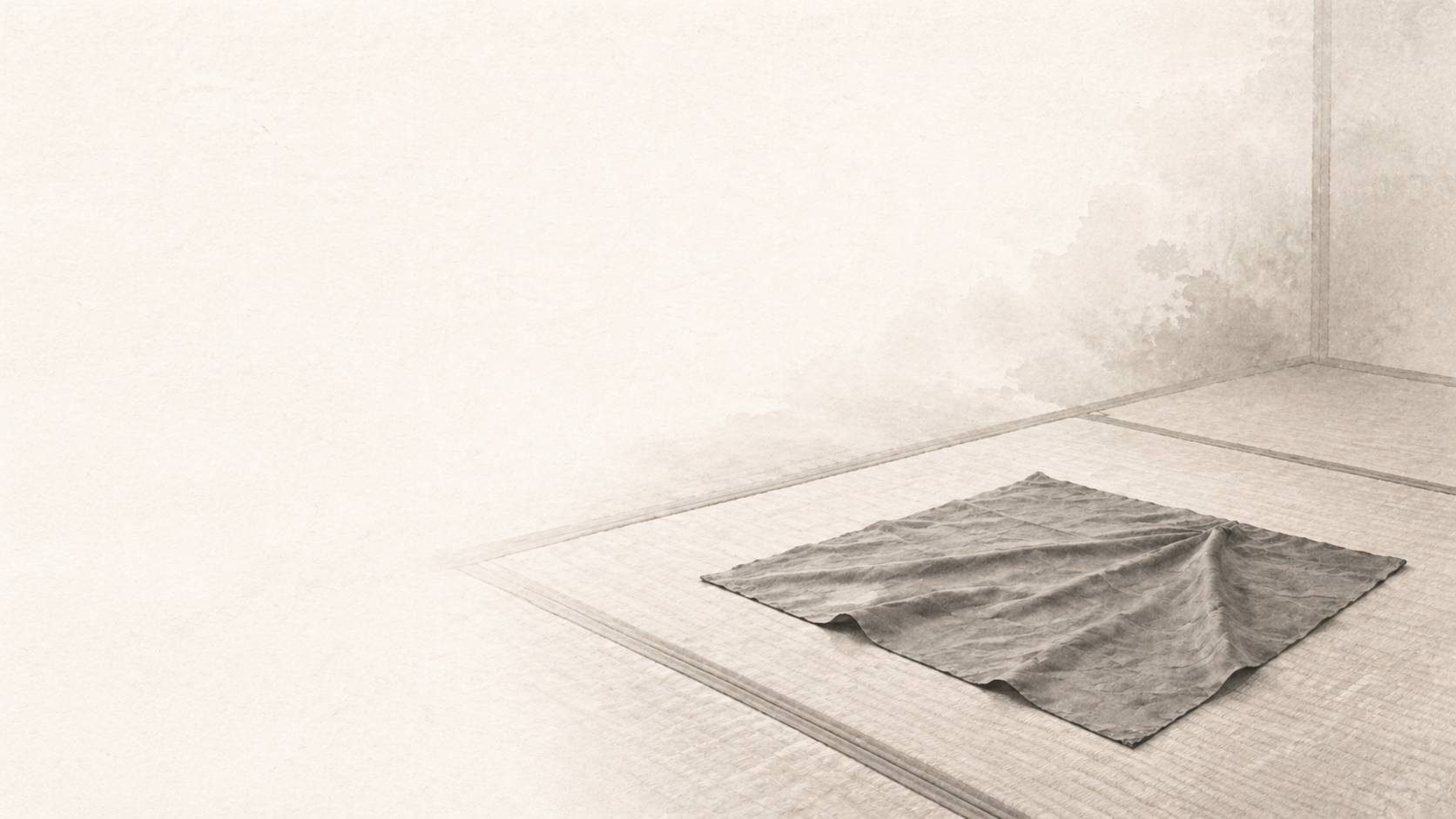
A single piece of cloth rests there quietly.
Spread open, it looks like nothing more than a square of fabric.
There are no fasteners, no frame, no rigid structure to hold a shape in place.
Nothing about it seems to insist on what it is meant to be.
At first glance, it appears to be almost nothing.
And yet, precisely because it is almost nothing, a furoshiki can become almost anything.
It follows the shape of what it wraps.
It responds to the intention of the hands that tie it.
A box becomes a parcel.
A bottle becomes something that can be carried.
Thrown lightly over the shoulder, it begins to resemble a bag.
Untied, it returns once more to being only cloth.
To have no fixed form can seem incomplete.
But with furoshiki, the feeling is strangely the opposite.
Its form is not fixed, not because it lacks purpose, but because its purpose has not been narrowed too soon.
A finished bag is certainly convenient.
But completion also closes other possibilities.
A box remains a box.
A bag remains a bag.
To be fully designed is also, in some quiet way, to have already given up other futures.
Furoshiki stands on the other side of that logic.
Because it is not fully defined, it can be born again in the hands of the person using it.
There is, perhaps, a quiet idea here, one often felt in Japanese tools and objects.
They do not press their use upon the person.
They do not insist on a single correct way.
They step back a little, leaving room for the movements of the hand and the needs of the moment.
A furoshiki does not say, hold me here, use me like this.
It simply offers itself.
Then it changes shape in silence, following what is needed.
There is a kindness in that silence.
Today it may wrap a gift.
Tomorrow it may hold a lunch.
On another day, it may gather together a few books.
Each time its role changes, it does not cling to the previous one.
Once untied, it returns without resistance to being a single plain cloth again.
In that, something distinctly Japanese seems to appear.
What has no fixed form may seem unstable.
And yet things that assume change from the beginning often possess a different kind of strength.
They do not survive by refusing change, but by allowing it.
They do not break so much as loosen.
They do not end so much as return.
That may be where the beauty of furoshiki lies.
When the knot is undone, the cloth falls back into a flat, quiet surface.
It carries faint traces of having been used, yet refuses none of its next possibilities.
What remains is not the feeling of something consumed and finished, but something closer to renewal.
There have long been such things in Japanese life.
Things that can be folded.
Things that can be untied and returned.
Things that move naturally into another use.
They are not showy, but they make life lighter.
By not being overmade, by leaving a margin of openness, they remain able to meet different moments as they come.
Perhaps the philosophy of furoshiki does not belong only to tools.
People, too, sometimes harden their own form too quickly.
This is what I should be.
This is how I must appear.
This is the role I am meant to serve.
And the more firmly one rushes toward a finished shape, the more quietly other possibilities disappear.
Furoshiki seems to suggest something else.
Do not decide the form too soon.
Tie when something is needed.
Untie when that moment has passed.
Not deciding everything in advance is not negligence.
It may be a way of protecting openness.
And this wisdom is not grand.
It does not arrive as doctrine.
It lives in ordinary gestures.
Wrapping.
Tying.
Carrying.
Opening.
Within such small movements, something without form takes form, and then returns again.
At moments, an old Buddhist phrase comes quietly to mind: Shikisoku zeku, kūsoku zeshiki―roughly, “form is emptiness, emptiness is form.”
That is not because furoshiki tries to illustrate philosophy.
It is because it shows, without explanation, that what appears to have shape is not always fixed in essence.
A form appears for a time, in response to circumstance.
Then it loosens, and something else becomes possible.
When wrapped, the cloth looks like a bag.
But it is not a bag forever.
The moment it is untied, that form disappears.
And because it disappears, another form can arrive.
This is not the resignation of inconvenience.
It is a freedom that refuses to be enclosed by a single convenience.
An object without a predetermined use asks a little more imagination from the person who uses it.
But in return, it stays close to a life in a deeper way.
Perhaps a good tool is not one that stands out, but one whose depth is noticed only afterward.
Furoshiki reveals its quiet richness most clearly when it is folded away.
After serving many roles, it ends once again with the face of a simple cloth.
It does not boast of what it has done.
It does not announce its usefulness.
And yet, when the next need arrives, it is ready to be offered again without hesitation.
There is a deep refinement in such restraint.
Furoshiki has probably endured not only because it was useful, but because something calmer could be felt beneath that usefulness.
That it is all right to change.
That one need not be fixed in a single form.
That one can be untied, and begin again.
A single cloth knows this without saying so.
When opened, it reveals a space.
When tied, it takes on a role.
When untied, it returns to quietness.
Within that gentle movement back and forth, life becomes a little softer.
And perhaps the human heart as well.
More in
Objects
Or wander further through
Archive