The Fading of Blossoms
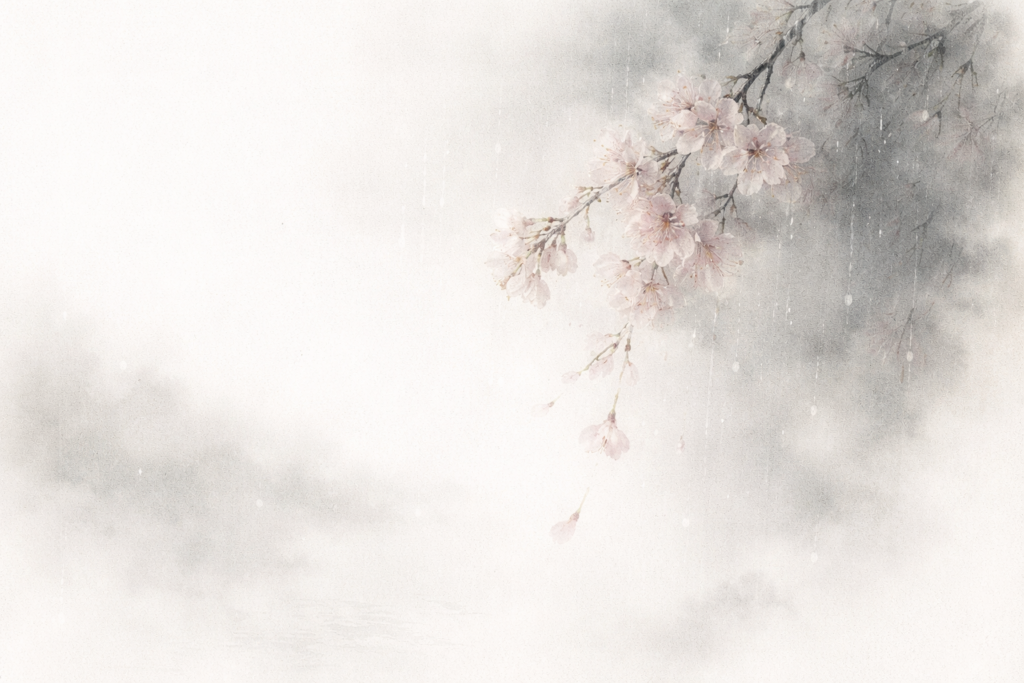
Spring rain continues to fall in silence.
The blossoms, surely vivid under clear skies not long ago, grow pale almost without notice as they are touched by rain and wind. They have not yet fallen. Their color simply shifts, slowly, quietly, but beyond doubt. Sometimes it is just such a small change that strikes the heart most deeply.
In a poem by Ono no Komachi, that quiet shifting appears in two forms at once.
Hana no iro wa
utsurinikeri na itazura ni
wagami yo ni furu
nagame seshi ma ni
One scene is plain to see: while the long rains of spring continue, the color of the blossoms fades away in vain. The flowers, exposed to the rain, lose their brightness little by little. Yet the poem does not end there.
The word nagame suggests both “long rain” and “gazing in thought.” The word furu can mean both “rain falling” and “passing through the world over time.” What begins as a poem about flowers quietly turns toward the self. While absorbed in thoughts of love and of life, one’s own beauty, too, has faded in vain. An outer scene and an inner one are placed within the same words, resting together without strain.
The brilliance of the poem lies first in this technique. Two scenes rise at the same time within a single waka, yet nothing feels forced. Landscape and feeling seem joined from the beginning, as though they had never been separate things.
What deepens the poem further is the figure of its speaker.
Ono no Komachi has long been remembered in Japan as a woman of extraordinary beauty. That such a woman should leave behind a poem that suggests the fading of her own appearance gives the verse a distinct shadow. This is not the sorrow of someone imagining beauty from afar. It is the gaze of someone who once stood within it, and who has noticed its change. That is why the poem carries more than lament. It carries depth.
The poem speaks of no dramatic event. It says only that the color of the blossoms has changed. Yet within that slight shift, the presence of a human life enters. What seems at first to be a view of spring rain becomes, before long, a reflection on time itself.
One begins by looking at flowers, and finds, quietly, that a human figure has appeared there as well.
That stillness is what makes the poem linger.
More in
Words
Or wander further through the Archive
Archive