A Small Prayer Swimming in the May Wind
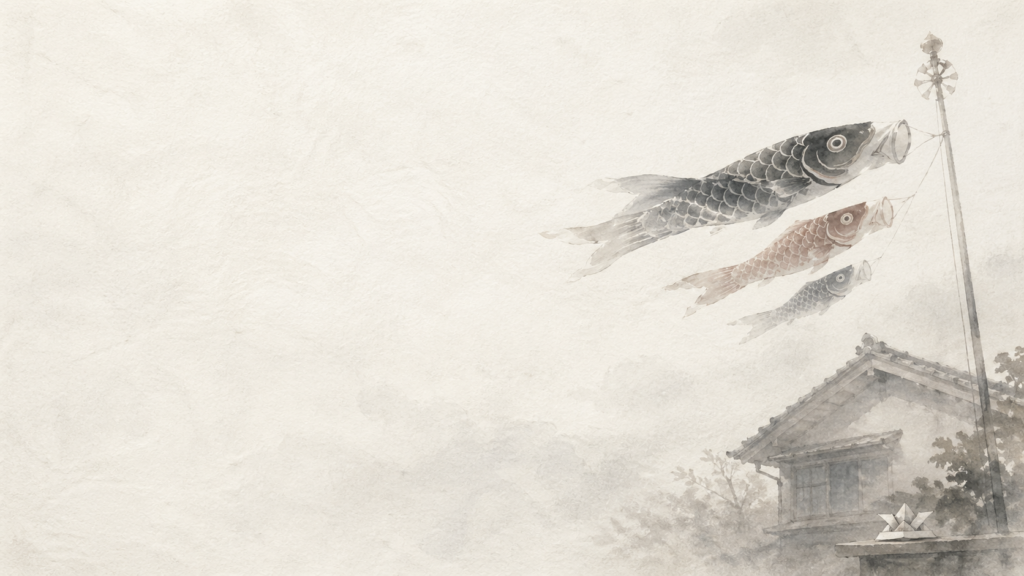
Toward the end of April, koinobori begin to appear in the sky above the town.
At first, one may see them only in the garden of a single house.
The next day, another set appears on a balcony nearby.
A little farther down the street, beyond an open space where the wind passes through, a large black carp slowly bends and sways in the air.
Some are five or six meters long.
On a tall pole in a wide garden, the black carp, like a father, swims with quiet dignity.
Below it follows the red carp, and beneath them, several smaller carp catch the wind.
Others are less than a meter long.
They hang modestly from the end of a laundry pole or from the railing of an apartment balcony.
Yet they, too, are swimming in the sky.
On windy days, the carp swell with strength.
When the wind stops, the cloth softens and droops, as if asleep.
Then another breeze comes, and the bodies fill again, as though remembering how to swim.
Around that time, one might also hear the children’s song about koinobori drifting from somewhere.
Children did not sing it because they had thought deeply about its meaning.
The season simply carried the song to them.
Carp were swimming in the sky, children were singing by the roadside, and somewhere inside the house, a May doll had been placed on display.
That was enough to know that May was near.
May 5 is Children’s Day in Japan.
Schools are closed.
Many children spend the day playing outside from the morning.
The familiar road to school looks slightly different on such a day. Without a schoolbag on one’s back, the street suddenly feels wider.
Some children wear helmets folded from newspaper.
Perhaps a father, a grandfather, or some other adult has folded one for them.
A newspaper helmet does not last very long.
If a child runs, it slips.
If the day is warm, it softens with sweat.
If handled roughly, its pointed corners soon collapse.
Still, a child wears it and goes outside.
Though it is only made of paper, it somehow makes the child feel a little stronger.
There is no enemy to fight.
And yet, a small breeze of bravery enters the chest.
The old seasonal festival connected with this day, Tango no Sekku, has long carried prayers for the healthy growth of boys.
The carp is said to be a fish that swims upstream against strong currents.
A wish was placed in its form: may the child grow with strength, able to rise through difficulty.
But for children, koinobori may not have been such a solemn lesson.
There was simply a great fish swimming in the sky.
That alone was strange enough, wonderful enough.
To feel that a flag had been raised in one’s own garden, somehow for oneself, was already a quiet kind of pride.
After playing for a while, children return home, where kashiwa-mochi is waiting.
The white rice cake is wrapped in an oak leaf.
The leaf is not eaten.
And yet without that leaf, it would not be kashiwa-mochi.
Before the sweetness of the rice cake comes the scent of the leaf.
A little green, a little damp, close to the smell of soil and trees.
A child bites into the rice cake while talking about the day’s play.
Who fell down where, whose paper helmet tore, whose house had the largest koinobori.
The stories are usually of no great importance.
Still, the parents listen.
They laugh now and then, and answer with small nods.
In the inner room of the house, a May doll may also be on display.
A warrior doll wearing armor and a helmet.
A small bow and sword.
A gold folding screen.
To a child, it looks a little frightening, and a little magnificent.
The doll changes the air of the house.
The tatami room becomes quieter than usual.
Although the doll has been displayed for the child, it is also something the child is not supposed to touch carelessly.
There is both celebration and restraint in that space.
Though the day is called Children’s Day, what was there was not only time for children.
It was also time for parents to look at their child.
Time for grandparents to look at the next generation.
Time when the house itself still had a slightly heavy, slightly warm outline.
Some homes held larger gatherings.
Relatives came together, special dishes were placed on the table, and the child’s name was called many times.
“You’ve grown,” the adults would say.
The child might not understand what exactly had grown, or how much.
But the adults smiled as they said it.
Perhaps there was something like confirmation in those words.
The child has come this far safely.
Another year has passed, and the child is still here.
The family was quietly confirming that fact with their eyes.
Until about half a century ago, such scenes could still be found here and there on May 5.
Of course, not every home was like this.
Not every family had a large garden.
Not every house displayed an impressive May doll.
Some children may not have eaten kashiwa-mochi at all.
Even so, when koinobori began to appear across the town, there was a feeling that the same season was being shared.
Each family’s small celebration seemed to mingle, just a little, with the wind outside.
Today, there are fewer chances to see koinobori than before.
Housing has changed, family forms have changed, and the ways of celebrating have changed.
Small koinobori hung from balconies, or handmade ones lined up in a nursery school yard, may now be closer to the landscape of the present.
But just because the carp have become smaller does not mean the wish has become smaller.
A cloth carp fills with wind.
A child looks up at it.
An adult is watching that child.
Perhaps the heart of the day is there.
Grow bravely.
Grow strong.
Grow straight.
If put into old words, perhaps the wish would sound like that.
But in reality, the wish is probably a little softer.
If you fall, you can stand again.
If you cry, you can go back and play again.
If you come home hungry today and bite into kashiwa-mochi with a healthy appetite, that is enough.
Koinobori swim high in the sky.
But the wish beneath them may be found much lower, inside the house.
Shoes scattered at the entrance.
The bent corner of a newspaper helmet.
Oak leaves left on a plate.
The back of a child asleep after a long day of play.
In each of these small things, the wishes of adults remain quietly.
The May wind blows.
The cloth carp swells once again.
It is a celebration lifted toward the sky.
And at the same time, it is a small prayer lit inside the home.
More in
Customs
Or wander further through
Archive