“Itterasshai”
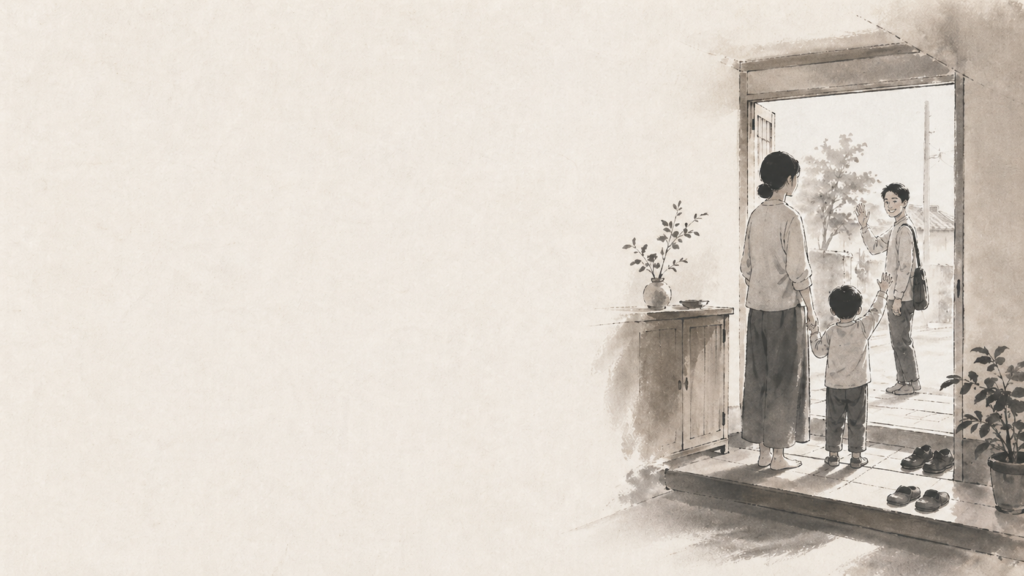
At the entrance of a home, there are moments when two kinds of air seem to gather at once: the air around the one who is leaving, and the air around those who remain behind.
The words exchanged while shoes are being put on are never grand. Will it be another late night, or an early return? What shall be made for dinner? What might happen after coming home? They are all small things. And yet, in the quiet of an ordinary morning, such small things can be heard with surprising clarity.
A single sentence ― It looks like I can come home early today ― is enough to brighten a child’s voice at once. Then the talk begins to open outward. Let’s play together when you get back. Maybe even take a bath together before that. With each little promise, something warm seems to gather, almost visibly, around the doorway.
Beside that excitement, there is also a gentler voice, lightly holding it in place. Do not ask too much of him. He must be tired from work. It is a soft kind of restraint, but not a cold one. It carries concern for the one who is leaving, while surely carrying, too, a quiet happiness that he may return a little earlier than usual.
There is also the brief apology that does not become heavy: Sorry for leaving so much to you. And the answer that does not make a show of sacrifice: It’s all right. Neither side lingers over the thought, and perhaps that is part of what makes the exchange feel settled. Care is present, but it is worn lightly.
Then comes another small offering. Shall tempura be made tonight, since he likes it so much? And in reply, something equally simple: Then I’ll look forward to coming home.
Nothing is being dramatically confirmed in these words. No one is trying to define love, gratitude, or trust. Those things are already there. The words only pass over them gently, as if smoothing the surface of something long familiar.
And then, at the end, come the phrases heard in so many Japanese homes:
Ittekimasu.
Itterasshai.
They are often translated simply as I’m off and Take care, but something quieter lives inside them. Ittekimasu carries the sense of going, but also of coming back. Itterasshai is not merely a farewell. It sends someone out while already holding open the place to which that person will return.
For that reason, these are perhaps not parting words in the usual sense.
They are spoken at the threshold, but what they hold is not separation. They hold the calm knowledge that even if people spend a few hours apart, the bond between them does not loosen. A day begins, someone steps outside, and still, the shape of home remains intact.
Perhaps that is why such ordinary phrases can leave such a quiet feeling behind.
They do not simply mark departure.
They gently affirm that there is, waiting somewhere behind the door, a place one belongs to.
More in
Scenes
Or wander further through
Archive