The quiet beauty of “Wabi-Sabi”
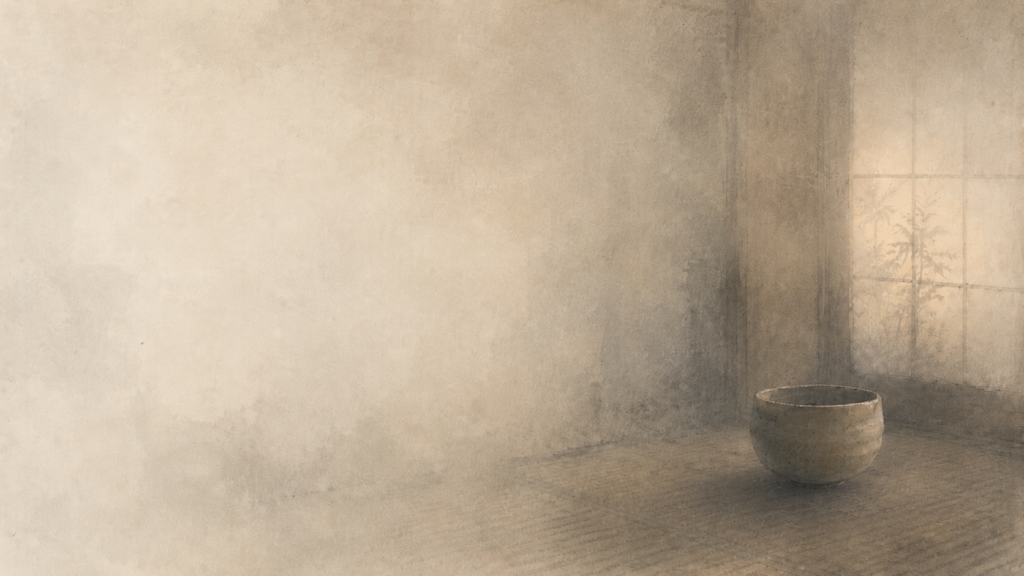
Evening light changes a room only slightly.
A wall that looked white during the day begins to hold a faint trace of gold.
The shadows of the shelves grow longer.
The lines of the tatami sink quietly into the dimness.
On a low wooden stand, the rim of a tea bowl is touched by a thin light.
The bowl is not especially well-formed.
Its rim has a slight wavering.
The glaze has not flowed evenly.
It does not reflect the light sharply.
Rather, it seems to absorb a little of it, and return only a little.
And yet, the eye stops there.
This is not simply a matter of admiring what is imperfect.
If there were an absolute form somewhere, perhaps this bowl would be a little apart from it.
But things do not exist as things alone.
There is someone who sees them.
There is the place where they are set.
There is the light of that day.
There is the time that has passed before this moment.
There is the memory of the hands that have held them.
The same bowl is not quite the same when it rests in a morning kitchen and when it sits in a quiet room at dusk.
It is not the same at a festive gathering and in the silence after someone has gone home.
It is not the same when held by young hands and when enclosed by hands that have grown older.
Value is not fixed inside the object.
It rises, each time, within the relation between the object, time, place, person, light, and memory.
Beneath this lies a sensibility long known in Japan as mujōkan ― an awareness of impermanence ― flowing like a narrow underground stream.
Everything changes.
People, places, light, relationships, even the timing of chance itself cannot remain the same.
For that reason, the same thing never appears twice.
And precisely because the same thing never appears twice, there are moments when essence briefly takes shape within a once-only convergence.
Perhaps wabi-sabi is the feeling that receives that essence as beauty.
Old things are not beautiful simply because they are old.
Broken things are not precious simply because they are broken.
Quiet things are not deep merely because they are quiet.
But when something old is placed in a certain light, in a certain silence, in a certain room, the layers of time may begin to show.
When something chipped is seen as something that has long been touched by someone’s hands, its damage may cease to be mere damage.
When something quiet appears as the form left after the unnecessary has fallen away, its stillness may no longer feel empty.
Wabi-sabi does not belong only to the qualities of an object.
A tea bowl itself is not wabi-sabi.
An old pillar itself is not wabi-sabi.
A moss-covered stone itself is not wabi-sabi.
Rather, these things may, at a certain time, in a certain place, under a certain light, within a certain memory, quietly make something come into being.
It is in that way of coming into being that people may feel beauty.
The word “perfection” sometimes gives things strength.
A completed form.
A polished surface.
A balanced shape.
A tension that does not permit anything to be missing.
There is beauty there, too.
But something that tries to be perfect also tries, somewhere, to resist change.
To no longer change.
To no longer be chipped.
To no longer waver.
Within that wish, beauty appears ― but so does a certain hardness.
Wabi-sabi exists a little apart from that hardness.
It does not see change as failure.
It does not see aging as defeat.
It does not judge a chip merely as a deduction from an ideal.
Instead, it tries to receive the form that appears here and now, within conditions that continue to change.
This is not resignation.
It is to see what passes as something that passes.
It is to receive what will be lost with care, precisely because it will be lost.
It is to know that, within what is not eternal, there may be a moment that touches more deeply than eternity.
There is a quiet strength in wabi-sabi.
This sensibility does not live only in tea bowls or garden stones.
It may live in human relationships.
It may live in aging.
It may live in memory.
It may live in work.
It may live in life itself.
The person who was here yesterday is not quite here today.
The self of yesterday is no longer here either.
Even when the same words are exchanged, their resonance changes slightly with the condition of the day, the mood of the day, and the memories that have gathered until that day.
Youth does not remain.
The body changes.
Memory, too, slowly changes its form.
Methods that once worked may no longer work in another time.
One may call this decline.
One may call it deterioration.
One may call it loss.
But the eyes of wabi-sabi do not stop there.
What is rising now, in this condition?
What still holds deeply together within these circumstances?
What remains quietly after something has been lost?
That is where they look.
To eyes that pursue only perfection, change becomes an enemy.
To eyes that find essence within change, change becomes information.
What has aged speaks of time.
What has been chipped speaks of having been touched.
What is quiet speaks of the outline left after the unnecessary has gone.
Wabi-sabi is the feeling that listens to those voices.
The evening light is already beginning to fade.
The shadow of the bowl slowly dissolves into the color of the tatami.
In a few more minutes, the room will have another expression.
But for those few minutes, the bowl was certainly there.
Not perfect.
Not eternal.
A little wavering, a little aged, simply placed in that room.
It was not trying to declare anything.
It was only offering, quietly, an essence that could appear only now, within a world that continues to change.
Perhaps wabi-sabi is the feeling that notices what has been offered.
More in
Objects
Or wander further through
Archive